

Commercial site work in Indiana goes smoothly when the plans, approvals, stormwater permit, road access and utility locates are settled before the first machine arrives. This checklist walks through each step in order and names the office to confirm it with.
Drawings, survey and soils
Commercial site work is built to a drawing, so the drawing has to be right. Before mobilizing, confirm you have a current boundary and topographic survey, a civil site plan with grades, elevations, storm structures and utilities, and an erosion and sediment control plan that matches the grading.
A geotechnical report should say what the soil will carry, what compaction the fill needs and how soft areas are handled. On former farmland in central Indiana, expect clay-rich till, wet swales and old field tile that is not on the survey. Checking the mapped soils on the NRCS Web Soil Survey early can flag wet ground before it becomes a schedule problem. Where drawing and ground disagree, raise it before dirt moves.
Local approvals and building permits
Site plan approval usually runs through the town, city or county plan commission or planning office, and the building permit through the building department. Each jurisdiction in Putnam County, Indiana, Hendricks County and Boone County sets its own process, review times and conditions, so confirm what applies to your parcel with the office that covers it.
Ask for the approved plan set and every condition in writing. Conditions often touch site work directly, such as landscape buffers, entrance locations, detention design or when erosion control inspections happen. Getting them onto the site contractor's drawings before the job starts is far easier than changing grades after the pad is built.
Stormwater: the IDEM construction permit
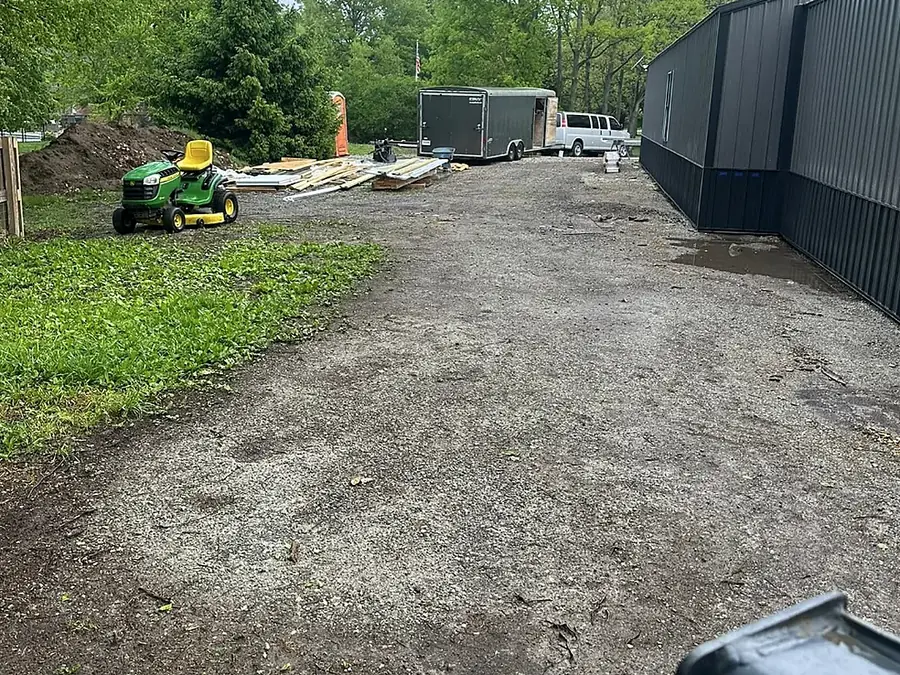
Any project disturbing one acre or more, which is most commercial ground, falls under IDEM's Construction Stormwater General Permit. Smaller sites can be included if they are part of a larger common plan of development. Coverage needs to be in place before land is disturbed, and covered projects show on IDEM's nSITE Explorer.
Since House Enrolled Act 1037 took effect on May 1, 2025, local construction stormwater ordinances, including those of MS4 communities, cannot be more stringent than the CSGP. Local programs still administer it in many places, so confirm with IDEM and your local office who reviews and inspects your site. Then install the stable entrance, perimeter controls and inlet protection first, and keep them maintained.
Road access, floodplains and the right-of-way
Connecting a site to a state highway needs an INDOT driveway permit, and excavation or grading on state right-of-way needs an INDOT occupancy permit. On county roads, the county highway department controls entrances and culverts. In towns, ask the street or public works office. Allow time for these, because the entrance is usually the first thing built.
If the site is near a creek or a mapped flood area, check the Indiana DNR Division of Water Floodplain Portal and ask about construction permits before grading. Fill placed in the wrong part of a floodplain is an expensive thing to take back out.
Utilities, locates and what is already in the ground
Indiana 811 needs at least two full working days' notice before digging, and the locates have to be kept current for the life of the job. Indiana 811 also publishes guidance on private locates, because lines installed by a property owner, such as site lighting or a feed to an outbuilding, may not be marked by the utility.
On former farm ground, expect field tile that no locate will find. Each cut tile should be logged, then repaired or tied into the new storm system, so water that used to drain the field does not end up under a new parking lot. Coordinate utility tie-ins with each provider early, because their schedule can hold up yours.
The order of work on site
A sound commercial site usually runs in this order. Stable construction entrance and perimeter erosion controls. Clearing and topsoil stripping to a stockpile. Mass grading to the plan, balancing cut and fill where the design allows. Proof-rolling the subgrade, with soft areas undercut and replaced. Storm, sanitary and water lines, then the building pad built in compacted lifts to the specified standard.
Testing happens along the way, by the testing firm the owner or engineer hires, and the work is built to pass it. Then come the stone base for paving, curbs and walks, and final grading of green areas. Keeping the trades in that order is what keeps the site dry and the schedule intact.
Closeout and why a site walk comes first
The job is not done when the paving crew leaves. Disturbed ground has to be stabilized with seed and straw, blanket or permanent cover, erosion controls removed only once the ground is stable, and the stormwater permit closed out with IDEM or the local program. Leftover spoil, stone and silt fence should be gone, and the final grades should match the as-built survey.
On Grade LLC handles commercial sitework across Central Indiana from Greencastle, including site preparation, drainage and utility installation and building pads. Send the civil drawings and schedule, then call or text Travis at (317) 203-8928 for a site walk. Estimates are free.
The Short Version
- Get the survey, civil plans, erosion control plan and geotechnical report in hand before mobilizing.
- Confirm site plan and permit conditions with the local planning office and building department in writing.
- IDEM's Construction Stormwater General Permit applies at one acre or more; controls go in first.
- INDOT, the county highway department or the town controls the entrance depending on the road.
- Call Indiana 811, plan for private lines and old field tile, and keep locates current.
Quick Answers
Do local stormwater rules in Indiana go beyond IDEM's permit?
Since House Enrolled Act 1037 took effect on May 1, 2025, local construction stormwater ordinances cannot be more stringent than IDEM's Construction Stormwater General Permit. Local programs may still review and inspect, so confirm who handles your site.
Who approves a commercial entrance onto a state highway in Indiana?
INDOT, through a driveway permit applied for in its electronic permit system. Excavation or grading on state right-of-way needs an INDOT occupancy permit as well.
What should be on hand before commercial grading starts?
A current survey, approved civil plans, an erosion and sediment control plan, a geotechnical report, stormwater permit coverage, road access approval and current Indiana 811 locates.
How is old field tile handled on a commercial site?
Each tile found should be logged and then repaired, rerouted or tied into the new storm system, so the water it carried has a planned route instead of collecting under pavement.
See the commercial sitework service or call (317) 203-8928.