

Land clearing cost in Indiana is set by what the ground will be used for, how much is growing on it, how it is cleared, what happens to the material and how easy the site is to work. There is no honest flat rate, so this guide explains each factor and On Grade prices the job after walking it.
Start with what the ground is for
The end use changes the price more than anything else. Opening up overgrown pasture, cutting a view or making a trail is surface work. The brush and small trees come down and the ground stays as it is. Clearing for a house, a pole barn, a drive or a lawn is a deeper job, because the stumps and roots have to come out of every place that will carry weight or be mowed.
Many properties are a mix of both. The pad and drive get fully cleared, the edges get mulched. Telling the contractor what you plan to build, and where, lets the quote match the job instead of assuming the most expensive version everywhere. Our land clearing cost per acre guide covers why acreage alone is a poor guide.
How much is growing, and how big it is
Light brush, briars and saplings on open ground come down quickly. Thick stands of mature trees take longer and leave far more material to deal with. Fence rows and old woodlots in central Indiana often hide wire, posts and dumped material that slow the machine and wear its teeth.
Mixed growth is the norm. A property that looks like brush from the road can have a band of big hardwoods along a creek or a fence line. Walking the whole area, rather than pricing from an aerial photo, is how those surprises get into the quote instead of into a change order. If any standing timber may have value, the Indiana DNR district forester can advise private landowners before it is cleared.
The clearing method
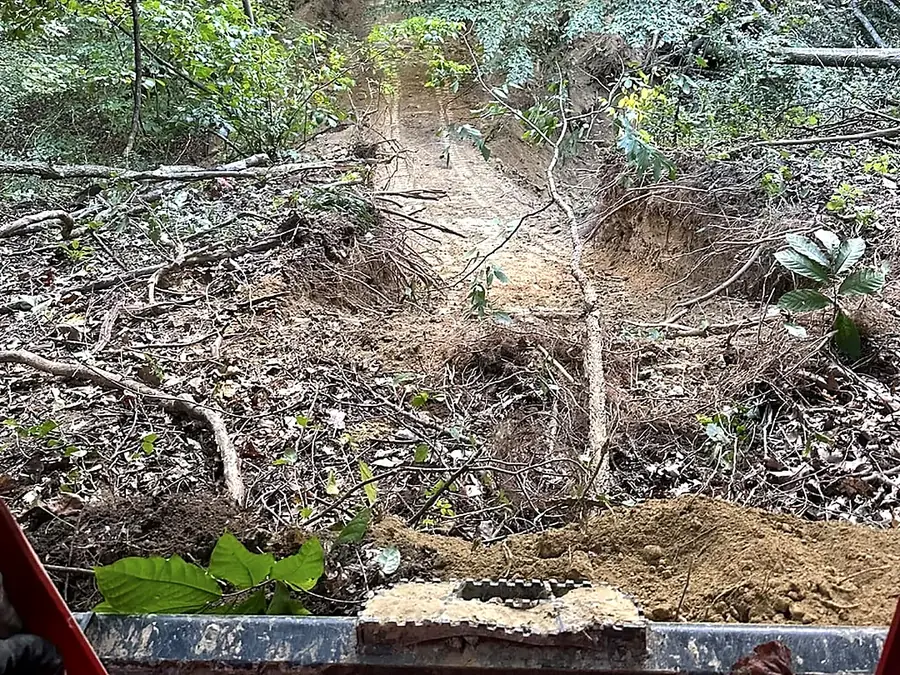
Forestry mulching grinds standing brush and small trees into chip and leaves it on the ground. It is quick, it leaves no pile and it protects bare soil. It does not remove roots, so it is not enough for a building pad.
Full clearing pushes trees over, pulls stumps and grubs out the root mat, then fills and compacts the holes. It is slower and disturbs more ground, but it leaves ground that can be built on. The method follows from the end use, and most jobs use some of each. Our forestry mulching versus land clearing guide sets the two side by side.
What happens to the material
Once trees are down, the wood has to go somewhere, and that choice often moves the price as much as the cutting. Chipping and spreading it on site is usually simplest. Hauling it off adds trucks, loading time and disposal. Burning is not a free default in Indiana. IDEM says open burning for land clearing needs its prior approval, and local ordinances and conditions apply as well.
Burying stumps on site is the option that comes back to bite, because buried wood rots and the ground above it sinks. Agree on how the material will be handled before the first tree comes down, so the quote and the work match.
Access, slope and wet ground
How the machines get to the work changes how long it takes. A wide gate and firm ground next to the clearing is quick. A long track through the woods, a steep slope, a creek crossing or a narrow lane past a house all slow every move.
Wet ground stops clearing faster than anything else. Much of central Indiana is clay-rich soil that holds water, and tracked machines working wet clay rut the ground and compact it, which then has to be repaired. Some jobs are better done in a dry spell or on frozen ground. If you have a deadline, say so early, because the weather and the soil set part of the schedule.
Permits, locates and erosion control
Clearing that disturbs an acre or more, or that is part of a larger common plan of development, falls under IDEM's Construction Stormwater General Permit, and erosion controls have to be in place and working. Grubbing stumps is digging, so Indiana 811 needs at least two full working days' notice first. Work near a creek may also touch the floodplain, which the Indiana DNR Division of Water Floodplain Portal will show.
Each of these adds planning and sometimes materials such as silt fence or seed and straw. They are not optional, so a quote that leaves them out is not the full price. Confirm the requirements for your site with IDEM, Indiana DNR and your county office.
Getting a real quote
Send the address, a rough outline of the area, what you plan to use the ground for and any deadline. Photographs of the growth and the way in help. Then Travis will walk it, mark the line with you and agree on how the material is handled.
On Grade LLC clears land and lots across Putnam County, Indiana, Hendricks and Boone counties from Greencastle. See our land clearing and forestry mulching service or our land clearing in Greencastle page, then call or text Travis at (317) 203-8928. Estimates are free.
The Short Version
- The end use of the ground sets the method, and the method sets much of the price.
- Density, tree size and hidden wire or debris change machine time.
- Material handling (chip, haul or approved burn) is a major cost driver.
- Access, slope and wet clay can slow a job more than the growth itself.
- Stormwater controls and Indiana 811 locates belong in the quote, not after it.
Quick Answers
Why can't a contractor give me a land clearing price over the phone?
Because the end use, the growth, the material handling and the access all change the work, and none of them show up in an acreage figure. A walk around the site turns those into a real number.
Does mulching everything cost less than clearing it?
Mulching is often quicker, but it leaves roots in the ground. That is fine for ground that stays as cover, and wrong for a house pad, drive or lawn. Most jobs use both.
Do I need permission to burn brush from a land clearing job in Indiana?
IDEM says open burning for land clearing needs its prior approval, and local ordinances can apply too. Check with IDEM and your local office before planning a burn.
Does clearing an acre or more trigger a state permit?
Land disturbance of one acre or more falls under IDEM's Construction Stormwater General Permit, and smaller sites can be included if they are part of a larger common plan of development. Confirm with IDEM for your project.
See the land & lot clearing service or call (317) 203-8928.