

Yard grading shapes the ground so rain runs away from the house and off the lawn to somewhere it can leave. Regrading fixes a yard that was shaped wrong or has settled, and on Indiana clay it is often the fix for a wet basement wall or a lawn that never dries.
What yard grading actually does
Grading is the shape of the ground. Done right, the soil falls away from the foundation on every side, the lawn sheds water toward a swale or a low edge, and that swale carries the water off the property or into a drain. Done wrong, the yard tips back toward the house, or it is so flat that rain just sits.
Regrading is the same work on a yard that already exists. Soil around a new house settles for a few seasons after the backfill goes in, and a slope that was fine on closing day can be running the wrong way a couple of springs later. Landscaping, a new patio or a shed can block the path the water used to take. Regrading brings the fall back so the water has somewhere to go again.
Why so many Indiana yards hold water
Much of central Indiana sits on clay-rich glacial till. Soils such as Crosby and Brookston drain slowly by nature, and Brookston sits in the low spots where water already gathers. That is why so much of this farm ground was tiled long before the houses came.
On clay, water does not soak in fast enough to hide a grading mistake. A flat yard stays wet for days after a storm, and a yard that tips toward the house sends water straight to the basement wall. Old field tile adds another twist. A tile line cut during building and never repaired can turn a dry corner into a spring, and it does not show up on any drawing. Finding the real cause comes before moving any dirt.
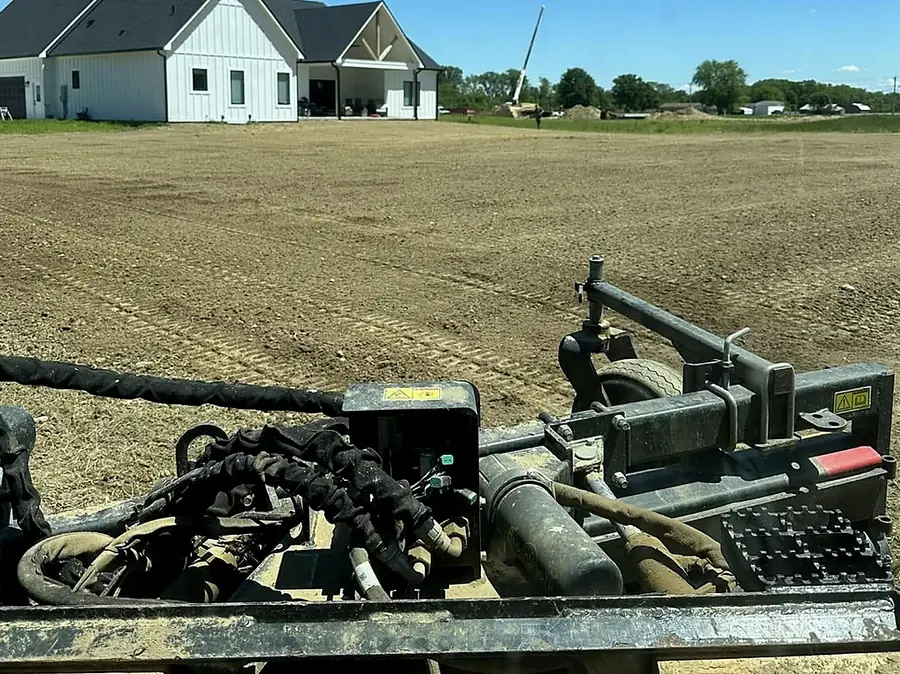
Signs your yard needs regrading
Walk the property during or just after a hard rain, because that is when the problem shows. Look for water standing against the foundation, wet patches on the basement wall, downspouts that empty into a puddle by the house, soil washing off a slope, or a lawn that stays soft for days.
Low spots where grass dies back each spring, mulch beds that wash out, and a sidewalk or patio that has tipped toward the house are other clues. So is a yard that pushes water onto the neighbour's lot, or takes theirs. Take photos while the water is there. They show a contractor in a minute what a dry-day visit can miss, and they help decide whether the answer is grading alone or grading plus a drain.
Grading, swales or drain tile: choosing the fix
Not every wet yard is fixed by grading alone. If the ground around the house simply runs the wrong way, regrading it and adding topsoil to build the slope back up may be all it takes. If water comes from uphill, a shallow swale can catch it and carry it around the house.
Where the yard is too flat to drain on the surface, or the low spot has no outlet, drain tile or a catch basin may be needed to move the water underground. Any pipe needs fall and a legal place to empty, and downspouts should carry roof water well away from the walls. A good fix often uses two or three of these together. The order matters too: pipe goes in first, then the final shape, then topsoil and seed.
Offices to check with before you regrade
A small regrade inside your own yard rarely involves a government office, but some jobs do, so ask before you dig. If a ditch on or next to your ground is a regulated drain, the county surveyor and the county drainage board have authority over it under Indiana's drainage law. Inside a town, the town office can tell you about local stormwater rules.
Changing how water leaves your lot toward a neighbour is worth a conversation before the work, not after. If the work disturbs an acre or more, IDEM's Construction Stormwater General Permit can apply. Any digging needs an Indiana 811 locate first. Confirm what applies to your property with each office.
What moves the price of yard grading
This guide does not give a price, because yards are too different for one number to mean anything. These are the things that move it. The area being shaped and how far the fall has to change set how much soil moves. Whether there is enough soil on site or topsoil has to be brought in matters next.
Access matters a lot on a finished lot. Gates, fences, trees, buried lines and play sets all slow a machine down, and tight yards can mean smaller equipment. Drain tile, catch basins or downspout lines add to the job. Last comes the finish: seed and straw or blanket, and the time of year it goes down. Spring and late summer into early autumn are the seeding windows that work in Indiana.
Why have On Grade look at your yard
Most wet yards have more than one cause, and the fix only works if the real one is found. On Grade LLC does finish grading, seeding and site restoration and drainage, tile and culvert work, so the grading and the pipe can be planned as one job instead of two.
Travis comes out, walks the yard with you, looks at where the water starts and where it ends up, and gives you a number. Every regrade starts with an Indiana 811 locate. On Grade is based in Greencastle and works across Hendricks and Boone counties. Call (317) 203-8928 and send photos of the yard in the rain if you have them.
The Short Version
- Grading is the shape of the ground; regrading fixes a yard that has settled or was shaped wrong.
- Indiana clay drains slowly, so a grading mistake shows up as standing water instead of soaking away.
- Watch the yard in a hard rain and take photos before anyone prices the work.
- Some fixes need drain tile or a swale as well as grading, and every pipe needs fall and a legal outlet.
- Ask the county surveyor about regulated drains and call Indiana 811 before any digging.
Quick Answers
Which way should my yard slope away from the house?
Away from the foundation on every side, so roof and lawn water moves out toward a swale, ditch or drain rather than back to the walls. The exact fall depends on the lot, so it is set on site.
Is regrading enough to fix a wet yard in Indiana?
Sometimes. If the ground runs the wrong way, regrading is the fix. If the yard is flat clay with no outlet, or water comes from uphill, it may also need a swale, drain tile or a catch basin.
When is the right time of year to regrade a lawn?
When the ground is dry enough to work without smearing the clay, and close to a seeding window. In Indiana, spring and late summer into early autumn give new grass the right start.
Who can regrade my yard near Greencastle or Danville?
On Grade LLC is based in Greencastle and does finish grading, regrading and seeding across Putnam County, Indiana, Hendricks County and Boone County. Call (317) 203-8928 to set up a visit.
See the seeding & restoration service or call (317) 203-8928.