

A pond works when the soil holds water, the land around it feeds enough water in, and storm flow has a safe way out. The cost to dig a pond is set by size and depth, the soil, what happens to the dirt and how hard the site is to reach, so it is priced on the ground rather than from a chart.
Start with the soil, because it decides everything else
The first question on any pond is whether the ground will seal. Clay holds water. Sand, gravel seams and broken rock let it go. Much of central Indiana is clay-rich glacial till, which is good news for a pond, but it changes from one field to the next, and in parts of Putnam County, Indiana, limestone sits closer to the surface than you would expect. The county has been quarried for limestone since the 1800s.
Before anyone prices a dig, look at the published soil map. Web Soil Survey, run by the USDA Natural Resources Conservation Service, shows the soils mapped on your ground and what they are rated for. A map is a starting point, not a test. A test hole dug at the pond site tells you what is really down there, and it costs far less than finding a sand seam after the pond is full.
Where the water comes from, and where it leaves
A pond is only as good as the land draining into it. Too little ground feeding it and the pond never fills, or it drops hard every dry August. Too much and every big storm pushes a flood of water through it, which means a bigger overflow and a stronger dam.
Every pond needs two ways out. The everyday overflow is usually a pipe or a standpipe that keeps the water at the level you want. The second is an overflow spillway, a wide, grassed channel cut into firm ground beside the dam, so that a storm the pipe cannot handle leaves across grass instead of running over the top of the dam and cutting it. A missing or undersized spillway is one of the ways an earth dam gets cut through.
Dug ponds and dammed ponds are different jobs
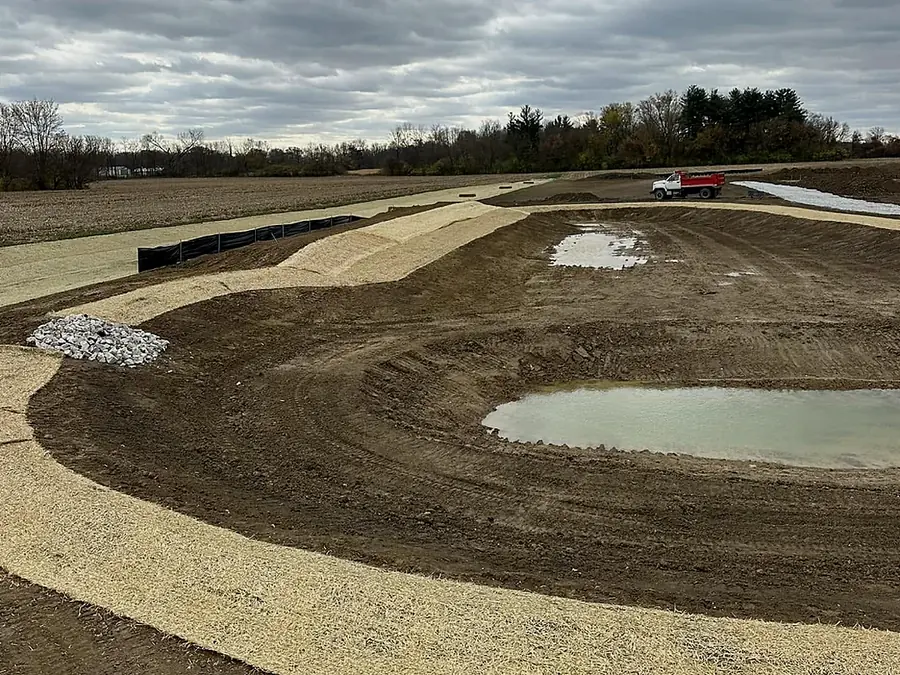
There are two basic kinds. A dug pond, sometimes called an excavated pond, is a hole on flat or gently sloping ground that fills from runoff or groundwater. It has little or no dam, so it is the simpler build. A dammed pond, often called an embankment pond, is built across a draw or low swale with an earth dam holding the water back.
A dam is a structure, not a pile of dirt. It needs a core of good clay keyed into the ground under it, placed in thin layers and compacted, with no trees, roots or topsoil buried inside it. Trees growing on a dam later are a problem too, because their roots open paths for water. If your site calls for a dam, expect more planning and more care than a dug pond, and expect the questions in the permit section below to matter more.
Cost to dig a pond: what moves the price
There is no honest price per pond, so this guide does not give one. These are the things that move the number. Size and depth come first, because they set how much dirt moves. The soil comes next: clay that seals on its own is one job, and ground that needs clay brought in or a liner keyed into the bottom is another. Spoil is the third. Spread on site as a pad, a berm or a raised drive, the dirt does useful work. Hauled away, it becomes trucking.
After that come the overflow pipe and spillway, any trees or brush to clear first, how wet the ground is when the machines arrive, how far they have to travel to reach the site, and shaping, topsoiling and seeding the banks so they hold. Engineering or permit work, where the site needs it, adds to the list.
Permits and offices to ask before you dig
Ask before the first bucket, not after. The Indiana Department of Natural Resources, Division of Water, has a Dam and Levee Safety Section. A dam comes under state jurisdiction based on the area draining to it, its height and the volume of water it holds, so a large dammed pond is worth a call to that section. If the pond is on or near a stream or in a floodplain, ask the same division about its floodway rules too.
If the work will disturb an acre or more of ground, the Indiana Department of Environmental Management's Construction Stormwater General Permit can apply. Your county Soil and Water Conservation District, and the NRCS staff who work with it, can help with pond planning, and your county planning office can tell you about local rules. Rules change and every site is different, so confirm with each office for your own ground.
Depth, banks and getting the pond you wanted
Shallow water warms up and grows weeds. A pond meant for fish or for clear water needs real depth over a good share of its area, not just a deep hole in one corner. The edges want a gentle shelf near the shore, so a person or a dog who slips in can walk out, then a steeper drop below it so weeds have less shallow ground to take hold of.
Think about use before the dig starts. A swimming pond, a livestock pond, a fishing pond and a pond that is mostly a view are shaped differently. Purdue Extension's county office in Greencastle is another good place to ask questions. Finished banks need topsoil, seed and straw so the first heavy rain does not wash them into the water.
Why have On Grade walk the pond site
A pond is easy to get wrong from a map and hard to fix once it is full. On Grade LLC is based in Greencastle and builds ponds as part of its pond construction and excavation work, from farm ponds to ponds that are mostly a view from the house. Closer to home, see pond construction in Putnam County, Indiana.
On a site visit Travis walks the ground with you, looks at where the water comes from and where it would leave, and talks through the soil, the spoil and access. Wooded sites can be cleared first through land clearing and forestry mulching, and every dig starts with an Indiana 811 locate. Call (317) 203-8928 to book the visit and get a number for your pond.
The Short Version
- Soil decides whether a pond holds. Check the soil map, then dig a test hole at the pond site.
- The land draining to the pond sets how it fills and how big the overflow and spillway need to be.
- The cost to dig a pond moves with size, depth, soil, spoil handling, access and the spillway, not a flat rate.
- Ask IDNR's Dam and Levee Safety Section about a dammed pond, and IDEM about stormwater if an acre or more is disturbed.
- Your county Soil and Water Conservation District is a good first call for planning help.
Quick Answers
How do I know if my land will hold a pond in Indiana?
Start with the NRCS Web Soil Survey map for your parcel, then dig a test hole where the pond would go. Clay that holds its shape when wet is a good sign. Sand, gravel or rock near the surface means the pond may need clay brought in or a liner.
Do I need a permit to build a pond in Indiana?
It depends on the pond. A dam can come under IDNR's dam safety rules, work near a stream can fall under floodway rules, and an acre or more of disturbed ground can bring in IDEM's construction stormwater permit. Your county may have its own rules. Ask each office before work starts.
What is the most expensive part of digging a pond?
Usually moving dirt more than once, or moving it off site. A pond where the spoil can be spread on the property, the soil seals on its own and trucks can reach the site in dry weather costs less to build than one where any of those is not true.
Does On Grade dig ponds near Greencastle?
Yes. On Grade LLC is based in Greencastle and digs, shapes and seals ponds across Putnam County, Indiana, Hendricks County and the west side of Indianapolis. Call (317) 203-8928 to set up a site visit.
See the pond construction service or call (317) 203-8928.