

Seed goes down as soon as the finish grade is set and the topsoil is loose, because bare graded ground starts to crust and wash with the first rain. In Indiana the window that gives the surest lawn is late summer into early fall, and when a job finishes outside it, the ground still gets covered and is then reseeded at the right time.
Seed right behind the grader, not weeks later
Freshly graded topsoil is at its most useful the day it is shaped. It is loose, it takes seed well and it has not yet been sealed over by rain. Leave it bare for a few weeks and the surface crusts, the clay underneath starts to show through in the low spots, and every storm carries some of that topsoil to the bottom of the slope.
That is why grading and seeding work better as one job than as two booked months apart. The last pass of the machine should leave a surface ready for seed, and the seed and straw should follow before the weather has a chance to undo the grade. If the house or the barn is not finished, the areas that are done can still be seeded and protected now.
The Indiana seeding window, according to Purdue
Purdue Extension's publication on establishing turfgrass from seed puts the strongest window for cool-season lawns in late summer to early fall, a little earlier in the north of the state than in the south. Soil is still warm, nights are cooler and weeds compete less. Purdue is plain that spring seeding is harder and often disappointing, though it is sometimes forced by a construction schedule. It also describes dormant seeding, where seed goes down on cold ground and waits for spring.
Your county Purdue Extension office can confirm timing and the seed mix for your ground and how much shade it gets. When a site wraps up in midsummer or late fall, the practical answer is usually to stabilize the soil now and plan the full lawn seeding for the next good window.
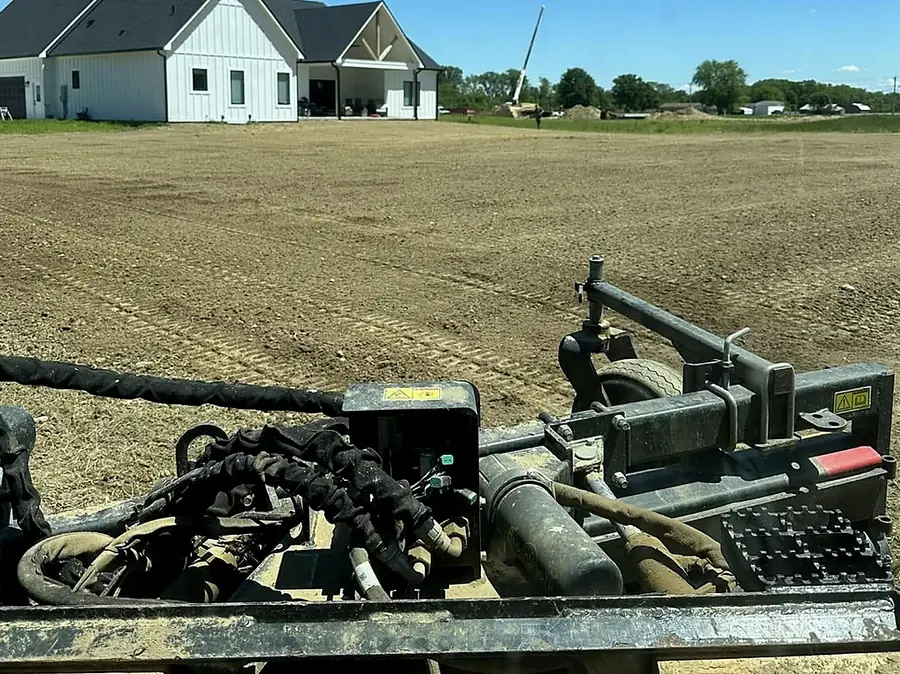
Construction ground is not a normal seedbed
A lawn area around a new build has been driven over by trucks, tracked by machines and often had subsoil mixed into it. Seed thrown onto that surface sits on a crust and dies when it dries. The topsoil that was stripped and stockpiled at the start goes back on, the compacted layer under it gets loosened, and stones, wire, concrete chunks and stakes come out before any seed does.
Purdue also recommends a soil test before seeding, so lime and fertilizer go on according to what the ground needs instead of guesswork. Your county Extension office can tell you how to send one in. Working soil while it is wet smears it and makes the crust worse, so a seedbed is prepared when the ground has dried enough to crumble rather than ribbon.
Seed, straw and blanket on slopes
Straw does two jobs. It keeps the seed from washing off and it holds moisture at the surface while the seed germinates. Purdue's guidance is to spread it lightly enough that you can still see about half the soil through it. A thick mat smothers the seedlings it is meant to protect.
On steeper banks, in swales and anywhere water gathers and runs, loose straw blows or floats away. Those areas want erosion control blanket pinned to the ground, and a channel that will carry real flow may need stone in the bottom rather than grass. Getting the grade right first matters more than any of it: a swale with the wrong fall will wash out under straw, blanket or anything else. Our guide to rough grading versus finish grading explains that last pass.
The first weeks after seeding
New seed must not dry out. Purdue describes light, frequent watering that keeps the top of the soil moist without saturating it, then fewer, deeper waterings once the seedlings are up. In late summer a few dry, windy days can lose a seeding that was otherwise done right, so plan who is watering before the seed goes down.
Keep vehicles, mowers and foot traffic off it while it establishes. Ruts pressed into soft seeded ground become permanent low spots that hold water. Thin patches are normal on a new lawn, especially where subsoil was close to the surface, and a light overseed in the next fall window usually fills them. Patches that stay bare and wet often point to a drainage problem, which our yard grading and drainage guide covers.
Seeding on a site with a stormwater permit
When a project disturbs an acre or more of land, it falls under IDEM's Construction Stormwater General Permit, and smaller lots inside a larger subdivision plan can be brought in as well. On those sites, seed and mulch are part of the erosion control plan rather than a finishing touch, and the silt fence and other controls stay until the ground is stabilized.
If you are building in a subdivision or on a larger parcel, ask the builder or the developer who holds the permit and what the plan requires before you remove anything. IDEM's stormwater staff can confirm whether the permit applies to your site. Pulling silt fence early because the yard looks green is a common way to end up with mud in the street and a phone call from an inspector.
Why have On Grade grade and seed together
On Grade LLC handles finish grading, seeding and site restoration from Greencastle across Putnam County, Indiana, Hendricks County, Boone County and the west side of Indianapolis. The same crew that sets the grade puts the seed and straw on behind it, so the surface does not sit bare waiting for another contractor.
If your build is wrapping up and the ground around it is bare, call or text Travis at (317) 203-8928. Tell him how big the area is, how steep it is and when the house or barn will be done. He will look at the ground and tell you whether to seed now or cover it and seed in the fall. Estimates are free.
The Short Version
- Seed as soon as the finish grade is set, before rain crusts and washes the topsoil.
- Purdue Extension puts the strongest seeding window in late summer to early fall; spring is harder.
- Construction ground needs topsoil back on, compaction loosened and debris removed before seed.
- Straw goes on lightly; slopes and swales need pinned blanket or stone.
- On sites under IDEM's construction stormwater permit, controls stay until the ground is stabilized.
Quick Answers
How soon after grading should grass seed go down in Indiana?
As soon as the finish grade is set and the topsoil is loose, ideally the same week. Bare graded soil crusts and erodes quickly, and seed takes far better on a fresh surface than on one that has sat through several rains.
Can I seed a new yard in Indiana in the middle of summer?
You can, but it is harder. Purdue Extension puts the strongest window in late summer to early fall. In midsummer heat new seed needs constant watering, so many sites get temporary cover first and the full seeding in the fall window.
Why did the grass seed around my new house wash away?
Usually the seedbed was compacted, the straw was missing or too thin, or water was running across the area in a concentrated path. Slopes and swales need blanket, and the grade has to carry water off without cutting a channel.
Who do I ask about seeding requirements on a construction site with a stormwater permit?
Start with whoever holds the permit, usually the builder or developer, and the erosion control plan for the site. IDEM runs the Construction Stormwater General Permit and can confirm whether it applies to your project.
See the seeding & restoration service or call (317) 203-8928.